





Your Colorectal Health, Our Priority
With our comprehensive suite of screening services and treatment options, our experienced colorectal specialist and medical team promise you peace of mind whilst ensuring a strong and healthy colon.




Dr Ho Kok Sun
Consultant Colorectal & General Surgeon
What is the Appendix?
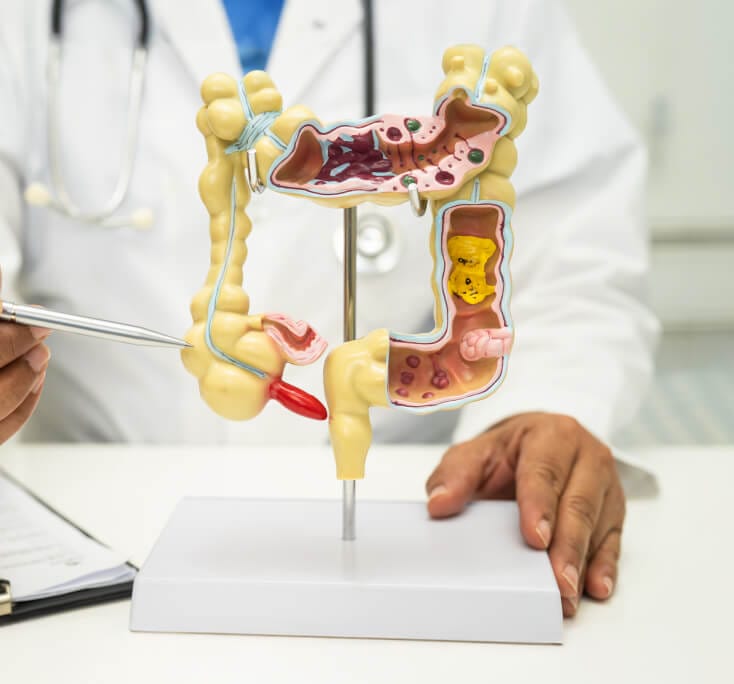
The appendix is a tubular structure at the lower end of the caecum, situated at the beginning of the colon, just below where the small intestines enter the colon. In most people, it lies in the lower right side of the abdomen.
Appendicitis occurs when there is infection or inflammation of the appendix. This is believed to be due to blockage of the lumen of the appendix, usually by a lump of hard stools (called faecolith). The mucus produced by the lining of the appendix then becomes trapped, causing the appendix to swell. The pressure affects the blood flowing in the wall of the appendix, and eventually causes it to break and the appendix to burst open, releasing all the infected material.
If there is still no treatment, the infection usually accumulates around the area and causes a large abscess. In some cases, the body is unable to contain the abscess and the pus spreads throughout the entire abdominal cavity, causing severe infection and possibly even death.
Types of Appendicitis
- Acute Appendicitis - This is a sudden inflammation of the appendix accompanied by severe symptoms that can worsen rapidly. This condition requires prompt medical attention to prevent complications like a ruptured appendix.
- Chronic Appendicitis - Unlike the sudden and severe start of acute appendicitis, chronic appendicitis occurs with milder, on-and-off symptoms and stays relatively constant. It is a rare condition with symptoms that may come and go over a long period, making it difficult to diagnose.
Many people underestimate how serious appendicitis can be. Please seek immediate medical attention should you experience symptoms.

What Are the Common Symptoms of Appendicitis?
What Are the Causes and Risk Factors of Appendicitis?
When Should I Consult a Doctor for Appendicitis?
How Is Appendicitis Diagnosed?
What Happens if Appendicitis Is Not Treated?
The primary treatment for appendicitis is the removal of the appendix - especially before it bursts. Rest assured that we can live well without an appendix.
How Is Appendicitis Treated in Singapore?
Almost all cases of appendicitis require the appendix to be removed. There are a few ways to do this:
- Open Surgery - This is the traditional way in which a cut is made across the lower right side of the abdomen and the appendix is removed through the cut. The cut is usually at least 4–5 cm long and can be even longer if there is severe infection around the appendix.
- Laparoscopic (Keyhole) Surgery - This is quite common nowadays. A cut is made at the umbilicus and a camera is inserted. Two small 5mm cuts are made further below to put in the instruments to free up the appendix and cut it off. The appendix is then removed through the cut at the umbilicus.
- Single Port Surgery - This is a variation of laparoscopic surgery in which a special device is inserted at the umbilicus. All the instruments are placed through the device, thus avoiding the other two small 5mm cuts. The surgery is performed in the same way as the standard laparoscopic surgery.
Most patients are discharged within 1–2 days after surgery. However, those with severe infection or abscess from an appendix that has perforated may need to stay longer until the infection is resolved. Hence, it is important to seek treatment early when symptoms of pain arise.
What Should I Expect Before and After Appendix Surgery?
Before Surgery
Patients may undergo imaging tests, blood tests and fasting before surgery. General anaesthesia is administered during the procedure.
During Surgery
The appendix surgery procedure typically lasts between 30–60 minutes. The surgeon removes the appendix through small incisions.
After Surgery
Patients are monitored for recovery and can usually resume liquids within a few hours. A soft diet may follow the next day. Most patients are discharged within 1–2 days after appendix removal surgery.
Full recovery can take a few weeks depending on the individual’s condition and the type of surgery performed.
What Are the Possible Complications After Appendix Surgery?
Complications after appendix surgery are uncommon and usually mild. As with any surgical procedure, some risks may occur, but most can be managed effectively with appropriate care.
Possible complications include:
- Wound infection: Redness, swelling, or mild discharge around the incision site may occur and can often be treated with antibiotics or wound care.
- Scarring: Small scars may remain at the incision sites, especially after keyhole appendix surgery.
- Localised abscess: A pocket of pus may develop internally and may require drainage or antibiotics.
- Incisional hernia: Rarely, a small bulge can form at the surgical site due to weakness in the abdominal wall.
Most patients recover well. Follow-up appointments help monitor healing and ensure smooth recovery after appendicitis removal surgery.
Frequently Asked Questions (FAQs) About Appendicitis
At what age does appendicitis typically occur?
How long can appendicitis go untreated?
How much does appendix surgery cost in Singapore?
How long does an appendix surgery take?
Will there be visible scars following a laparoscopic appendicectomy?
Can a person live without an appendix?
Meet Our Appendicitis Specialist in Singapore

Dr Ho Kok Sun
Consultant Colorectal & General Surgeon
MBBS (Singapore), M Med (General Surgery) (Singapore)
FRCS (General Surgery) (Edinburgh), FAM (Singapore)
Dr Ho Kok Sun has been treating appendicitis for over a decade and was the past President of the ASEAN Society of Colorectal Surgeons and the Society of Colorectal Surgeons (Singapore), as well as a founding member of the Eurasian Colorectal Technologies Association. Dr Ho was actively involved in the training of medical students and residents, and has published widely in reputable journals and book chapters. He believes that treatment should always be personalised to the patient’s needs.